St. Petronius bread is a celebratory bread prepared on October 4, when the city of Bologna celebrates its protector.
The recipe has been deposited at the local Chamber of Commerce since 2005, along with many other traditional recipes from the city and the Bologna area. When I say traditional, I don’t necessarily mean an ancient recipe dating back centuries.
Often, it is a food habit that spread and took root during the 20th century. This means that it is a historical recipe even if it is not ancient.
I personally discovered this recipe recently. This may be completely normal, given that I was born and raised in Romagna. Still, it is unusual considering I have lived in Bologna for over twenty years. Even my husband, who was born and raised in Bologna was unaware of its existence until a few years ago. When, for the first time, we both saw Sonia Peronaci, a famous Italian food blogger, cook it on a TV show.
I can’t tell you how surprised we were!
From that moment, I began researching its origin and tried many different recipes in various trials.
Its history is interesting.
The recipe, as I wrote, is deposited, a clear sign of its belonging to the territory. Even The Slow Food Dictionary to Italian Regional Cooking (Slow Food Publishing) mentions Pane di San Petronio, referring to its double leavening.
Yet the Sorelle Simili, internationally renowned chefs and bakers from Bologna and daughters of a Bolognese baker, do not mention this bread in any of their books. My mother-in-law, who attended their cooking classes when she was young, does not remember ever hearing it mentioned.
Some recently published books mention the recipe, which still leaves some questions unanswered about its history, which I hope to resolve soon.

Who was Petronius?
He was the son of a Roman prefect, and the saint’s hagiography recounts that, like St. Francis centuries later, he left a life of luxury to become a religious figure.
Petronius arrived in Bologna in the early 400s AD. He worked to rebuild the city, which had been devastated by barbarian invasions. Appointed bishop in 431 AD, he lived in Bologna until he died in 450 AD.
The good man was loved during his lifetime and, after his death, for the good he had done for the city, the free Comune of Bologna elevated him to the patron of the town in 1253. In 1388, construction of the Basilica dedicated to him began. According to the original project, this church had to be the biggest in the world, surpassing in size even St. Peter’s in Rome.
The project was then halted by the Pope, who could not allow his Basilica, St. Peter’s in Rome, to be smaller than the one in Bologna.
A little-known historical curiosity.
Although the Church of San Petronio is one of the largest in Europe and overlooks the city’s main square, it is not Bologna’s cathedral.
The city’s cathedral is in fact the Church of Saints Peter and Paul, located in Via dell’Indipendenza (a street built in the second half of the 19th century that changed that part of the city).
St. Petronius bread
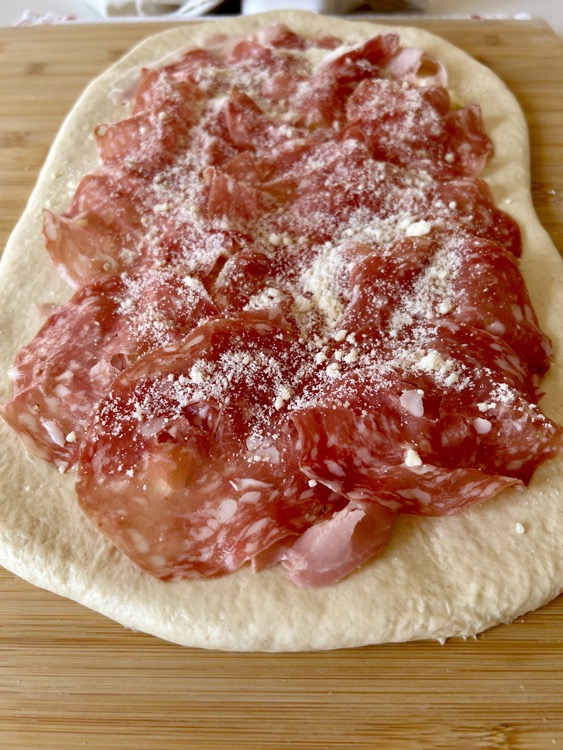
This bread is a twice-leavened dough and is usually stuffed with prosciutto and Parmigiano Reggiano shavings, but you can also use grated cheese and cooked ham (prosciutto cotto) or thinly sliced salami instead of prosciutto crudo (as I did, using cooked ham and salami).
The last time I made it, I chose to use a mix of 00 flour and spelt flour. You can use whichever flour(s) you prefer.
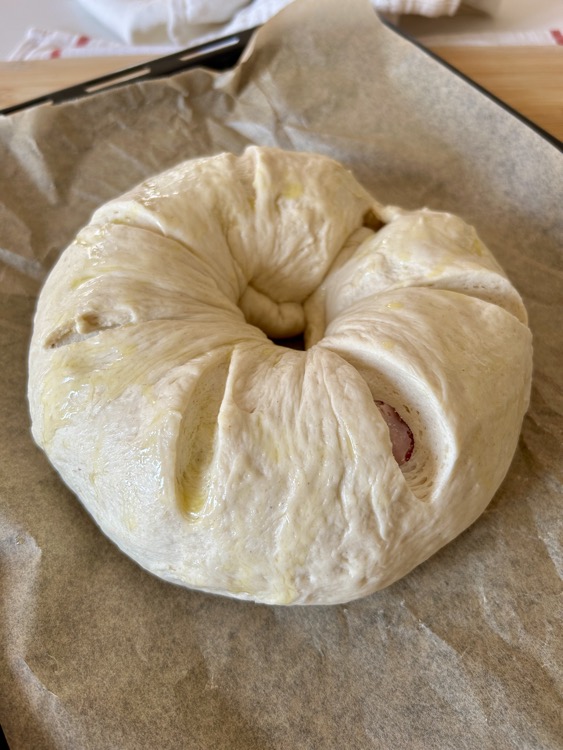
Part of the butter is used in the dough, and the remaining flakes are inserted into the incisions made on the surface of the bread before baking.
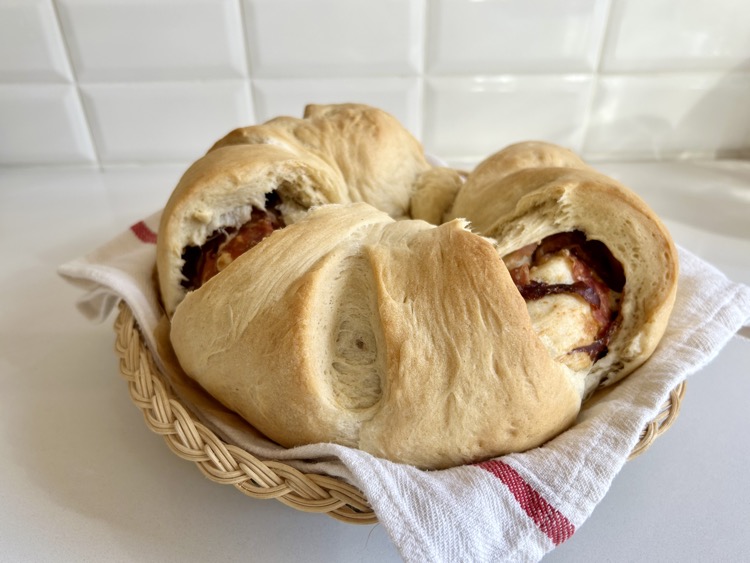
I also put a few flakes of butter on the base of the rolled-out bread dough before filling it, so that the cold cuts stay softer. This bread, which is stuffed and soft on the inside, has a golden, crispy crust on the outside that is neither too hard nor too soft.
St. Petronious bread is perfect for slicing and sharing as an appetizer or for the San Petronio lunch, a holiday that the Bolognese celebrate at the table.
Buona cucina, Monica
Pane&co of Bologna
- Streghe: thin, crispy bread, one leads to another like cherries (RECIPE)
- Crescente: irresistible local focaccia stuffed with ham (RECIPE)
Keep in Touch
- To receive unpublished recipes, tips, and food stories, sign up for the Tortellini&CO newsletter.
- Follow me on Instagram.

St. Petronius bread of Bologna
Ingredients
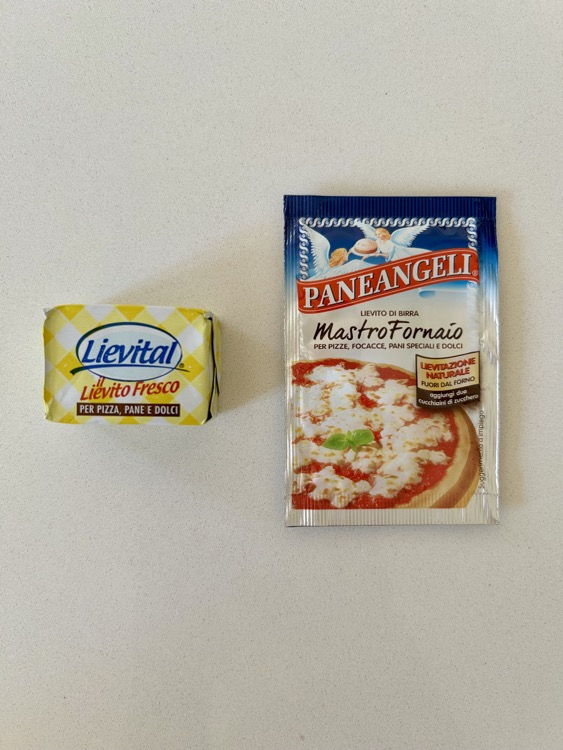
- 25 g of fresh yeast or 7 g dried yeast (look the picture below the recipe)
- 1 g of honey
- 50 g of warm water
- 250 g of 00 flour
- 250 g of spelt flour
- 200 g of lukewarm water
- 20 g of heavy cream or milk
- 25 g of butter
- 6 g of fine salt
Filling
- 30 g of butter
- 100 g of prosciutto cotto (cooked ham) or prosciutto crudo or salami (thinly sliced)
- 60 g of grated Parmesan cheese
Instructions
- Crumble the brewer's yeast into a bowl and dissolve it with 50 g of warm water and the honey. I suggest rehydrating dry yeast in the same way. Then, set aside.
- In the bowl of a planetary mixer, combine the two flours. Add the dissolved yeast and all the remaining ingredients except the salt.
- Knead for 3 minutes with the dough hook on speed 1, then add the salt and continue kneading on speed 2 for another 7 minutes.
- The dough should be soft but not sticky. If necessary, adjust the dough as follows: if it is too hard, add hot water one tablespoon at a time; if it is too sticky, add more flour a little at a time.
- Cover the bowl of the planetary mixer with plastic wrap and let it rest for 1 hour at room temp, or until it has doubled in size.
- Knead the bread again for a few minutes on a lightly floured pastry board, then shape it into a ball. Cover the ball with a cloth and let it rest for 15 minutes.
- After this time, preheat the oven to 200°C (392°F) on the static setting. Then roll out the dough with a rolling pin into a rectangle about 2 cm thick, 50 cm long, and 25 cm wide.
- Place a few knobs of butter on the surface, remembering to set aside some of them, sprinkle with Parmesan cheese, arrange the prosciutto or salami, sprinkle with more Parmesan cheese, and from the long side roll the dough into a tube. Join the ends and use a knife to make deep incisions on the surface where you will place the last knobs of butter.
- Brush the surface with a bit of olive oil. Place a knob of butter where you have made the incisions.
- Bake in a preheated oven for 15 minutes, then reduce the temperature to 180°C (350°F) and continue baking for an additional 25 minutes.
- Allow the bread to cool before slicing.