I am walking through the streets of the Quadrilatero, which, in Bologna, has been a market area since the Middle Ages. I stop to look at the fish displayed on the counters of a fish market, and following an impulse, I buy some baby octopus.
With the bag in my hand and in mind the fishmonger’s tips (you can find them in the recipe), I think back to the fragrant, thick oil-like stew grandma Sara used to prepare.
With the baby octopus stew, which in Italy is also a sauce, she would season all kinds of pasta, dry and fresh. And polenta.
I still remember those summer dinners.
The white tablecloth of light cotton covers the table. And ultimate protagonist is the large clay pot with the stewed baby octopus. In the crock are also slices of golden bread that look like Ulysses’ sirens. An irresistible lure.
Suddenly another memory bursts in my head, “Monica shall we go get chickpea flour?”
With that expression, nonna meant going to the pantry, which, at home, is and was the home cellar. A place I always loved, perhaps because of the scents emanating from the cassettes and demijohns, and the brightly colored jars of fruit and pickles.
I was a lucky child. In the 1970s, when the food industry had already changed the eating habits of Italians, pushing recipes and knowledge from peasant tradition far from the table, Grandma was still cooking lost dishes.
It took me years to realize that those flavors and knowledges are, perhaps, my most precious legacy. And even longer to think about what to do with them.
From this recent awareness comes the rediscovery of an overlooked part of my identity. The same journey from which the blog takes shape.
Yesterday’s and today’s cuisine
Have you also noticed that yesterday’s cucina povera dishes that, fortunately, we are rediscovering in Italy, have become prized and gourmet dishes? And how many recipes have we forgotten?
In Emilia-Romagna, especially in Bologna and Romagna, legumes were a staple food: they were cheap and satiating. Legume ragù replaced meat sauce; polenta (made of corn or semolina or chickpeas) was a main course served with what was available (even nothing). If today purè means mashed potatoes, in the past, purè was of peas or lentils.
Baby octopuses, once less expensive than an octopus, are no longer the poor fish I used to buy with grandma.
I remember when we would go out together early in the morning and, hand in hand, from Milano Marittima, we would reach Cervia’s canal port by crossing an old wooden footbridge.
When we arrived, fishermen were unloading boxes of fresh Adriatic fish for restaurants and hotels but did not disdain retail sales.
Nonna would choose calmly and wisely. For instance, I remember delicious Adriatic soles and clams. The latter, small and tasty, in Romagna are called poverazze or telline. But there were also octopuses, squills, squids, cuttlefish, scorpionfish, mussels, sardines, and whitebaits. As a child, I ate a lot of fish often.
Naturally cooked Romagna-style. I cooked octopus stew Romagnola style. A lesser-known seafood cuisine compared to that of other Italian regions, but so good.
A kind of cucina povera where the fish is the protagonist.

Baby octopus stew and chickpea polenta
I chose to pair the baby octopus sauce, cooked Romagnola style, as grandma used to, with a soft chickpea polenta.
I find its delicate flavor perfect for accompanying the savoriness of the baby octopuses that comes out during the cooking. And if you make the mistake of salting, you don’t eat them anymore.
Both are forgotten recipes by many people in Emilia-Romagna.
If you do some web research, baby octopus sauce seems to belong only to southern regions. And the chickpea polenta to Liguria and Sicily.
I do not know if mine is a mission impossible. For sure, my culinary journey to recover recipes from the Via Emilia has taken on the same thick, solid density as the baby octopus stew that Grandma Sara used to make. And that’s what sustains me and encourages me to keep going. As well as the affection I receive from those who have the goodness to read and cook with me.
Tie on your apron.
Are you ready to cook a recipe that will pleasantly surprise you? I hope so.
Buona cucina, Monica


Baby octopus stew and chickpea polenta
serves 4
List of the Ingredients
Chickpea polenta
250 g chickpea flour
1 liter of water
salt to taste
Baby octopus stew
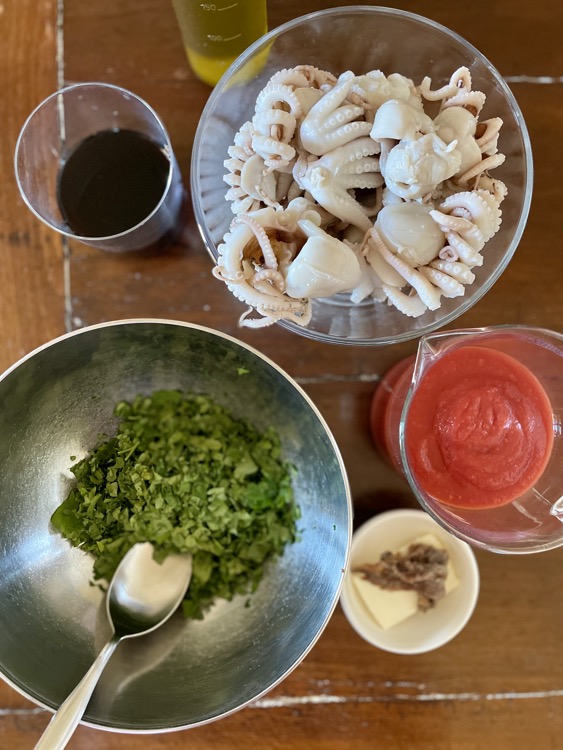
1 kg baby octopus, already cleaned
600 g tomato sauce
200 ml water
2 anchovy fillets in oil
chopped fresh parsley, 2 tablespoons
100 ml red wine
olive oil, butter, salt to taste
Method
Tip for having soft baby octopus:
Bring water to a boil with a few drops of lemon (or vinegar), turn the heat, then add the fish, already cleaned and rinsed under running water.
Let them soak few minutes and drain. I leave them whole, but you decide for yourself.
Meanwhile, gently melt the anchovy fillets with one tablespoon of olive oil and a knob of butter in a pot. Add the parsley, stir, and add the baby octopus as well. The secret to this sauce is not to add salt. The baby octopus tends to become very flavorful while cooking.
Cook for two minutes while stirring, deglaze with red wine, lower the stove flame to low, cover with a lid, and do not touch for 5 minutes.
Then add passata, water, olive oil, and stir.
Cook for about 40 minutes over a gentle flame, stirring occasionally.
Taste and, when cooked, add salt to taste. Turn off the stove.
Chickpea polenta
Bring one liter of salted water to a boil, pour in all the chickpea flour, lower the heat, and cook for 20 minutes, stirring.
Tip: chickpea flour tends to make lumps. If it happens, use an immersion blender to smooth and put it back on the stove.
Pour the hot polenta onto plates and cover it with some spoonfuls of the baby octopus stew.
In summer, let the polenta cool, cut it into slices, and serve it with warm fish sauce or at room temperature.