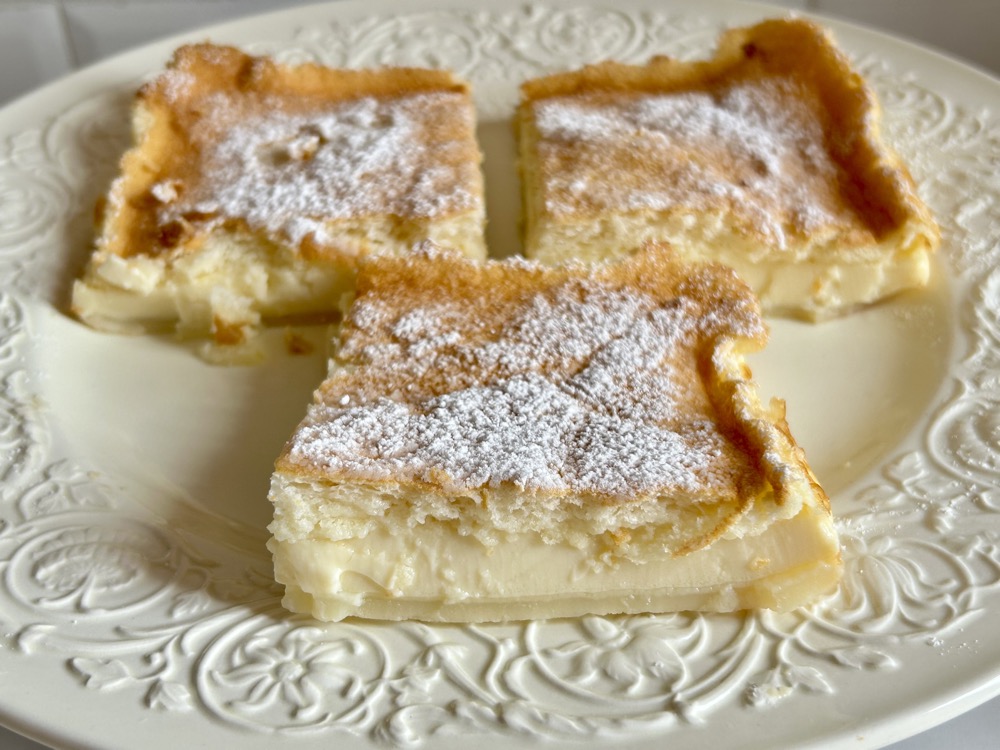
In the rural Romagna of long ago, the latteruolo was a gift that, on the occasion of Corpus Domini, a religious holiday that in the countryside marked the end of the harvest, the sharecropper’s wife would prepare for the landlord’s family.
When milk was plentiful, azdore would prepare the latteruolo, which is essentially a milk pudding and belongs to the same family as fior di latte, latte alla portoghese, latte in piedi, and crème caramel, only without the caramel sauce.
Considered a rich and restorative dessert, it was traditional to offer it to new mothers and considered a special food for children.
Times have changed. Sharecropping no longer exists, the feast of Corpus Domini is now a minor event, most women give birth in hospitals, and latteruolo is a somewhat forgotten dessert.
How about trying this homemade, rustic dessert?
Origin of the Name and Ingredients of the latteruolo pudding milk
The name latteruolo or lattaiolo derives from the Latin lacticinum but could also be a direct derivation of the word milk. Latteruolo is also known as casadello, not to be confused with the Neapolitan casatiello. However, both originate from the common Latin root caseus (cheese), which, in both recipes, indicates the presence of dairy products such as cheese or, in this case, milk.
Whether it’s called latteruolo or casadello depends more on family tradition than on the region.
The ingredients are typical of today’s pantry and that of the peasantry of the past: milk, sugar, and eggs, to which you can add flavorings like vanilla or lemon zest.
Apart from sugar, which was expensive and used sparingly, milk and eggs were readily available and affordable to (almost) each farmer. For this reason, fior di latte, despite local variations, is part of the culinary traditions of various countries around the world. In Italy, latteruolo is common in other regions, such as Tuscany and Abruzzo (where it is known as lattacciolo).
Nonna Sara’s latteruolo and mine
As Artusi also wrote in the introduction to the Latteruolo pudding milk recipe (No. 694): “It is a very delicate dessert that, in some parts of Romagna, and perhaps elsewhere in Italy as well, farmers bring as a gift to their landlord for the Feast of Corpus Domini”.
In my childhood home, it was called latteruolo and was more of a Sunday dessert than a holiday one. At Easter, Grandma preferred the more complex flavor of Portuguese Milk or other desserts.
Her version differed from the one the sharecropper’s wife once brought to the landowner. In those days, there were no one-use baking pans like today’s. For this reason, to deliver the dessert, it was baked in a shell of flour and water called pasta matta. It wasn’t eaten but served as a container, itself wrapped in a dishcloth.
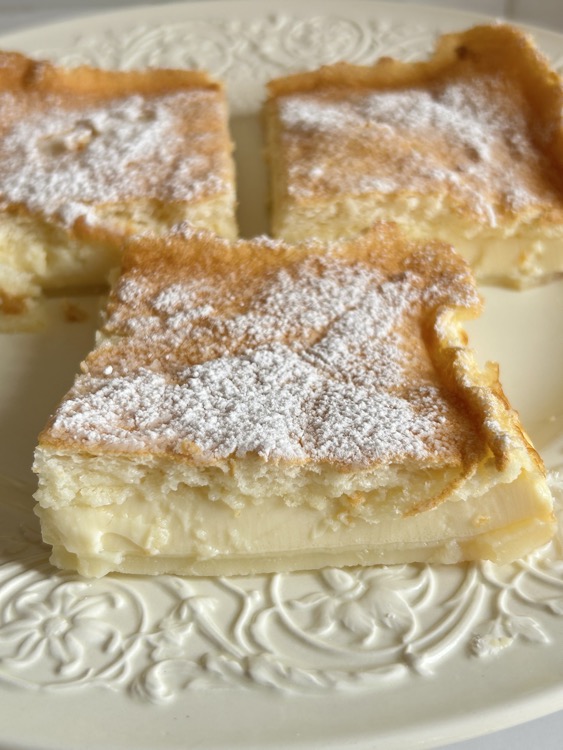
Since the dessert was for the family, nonna made it without the pastry crust and, after baking, placed the latteruolo on a serving plate and dusted it with powdered sugar. In fact, even though the dessert is a milk pudding, its texture is anything but delicate. Or rather, it’s less delicate than you might imagine.
My nonna followed Artusi’s recipe for Simple Latteruolo (the one without the outer crust, no. 695). I made a version very similar to my nonna’s.
Here’s what I’ve changed from my grandmother’s recipe:
- I make a smaller batch using ½ liter of milk instead of a liter, and 3 eggs instead of 6. My grandmother’s version was very large, enough for 8–10 people. Mine serves 4–6 people.
- I skip the boiling step, which doesn’t make sense to me since I use long-life milk.
- If you like, you can boil the milk with sugar and then mix the eggs into the mixture, either whole or with the egg whites whipped separately. But the milk cream will take on an amber color more reminiscent of Portuguese milk than the light, delicate hue of the latteruolo.
- If you choose to boil the milk with lemon zest and sugar for at least 30 minutes and notice lumps, strain the mixture before combining it with the eggs.
- To give the latteruolo more structure, I prefer to beat the sugar with the egg yolks rather than dissolve it in the milk on the stove.
The dessert has a simple flavor that you can make special by serving it with fresh fruit or whipped cream aside.
Keep in Touch
- I write a newsletter called Kitchen Notes from Bologna, where you can find stuff about food history, culinary memories, and recipes.
- I’m on Instagram!

Latteruolo pudding milk
Equipment
- electric whisk
- spatula
- 2 bowls
- 1.8-liter baking pan. Square, 22x22 cm; round, 22 cm; or rectangular, 20x24 cm. In any case, the sides of the pan must be at least 4 cm high.
Ingredients
- 3 eggs, at room temperature, 185–190 g
- 70 g of granulated sugar
- 50 g of potato starch
- a little grated lemon zest
- 1/2 teaspoon of natural vanilla extract
- 1/2 liter of milk at room temperature
To decorate
- powdered sugar to taste
Instructions
- Preheat the oven to 170 °C (325 °F), on the conventional setting.
- Separate the egg yolks from the whites and set the whites aside.
- Add the sugar, ½ teaspoon of natural vanilla extract, and the lemon zest to the egg yolks, then beat with an electric whisk for 3 minutes or until the mixture is light and fluffy.
- Add the potato starch all at once, then mix with an electric whisk for a few minutes.
- Using a whisk, stir the milk into the egg mixture and set aside.
- Beat the egg whites to stiff peaks with an electric mixer, then fold them into the milk mixture a little at a time with a spatula.
- Line the pan with wet and squeezed parchment paper. If you're not using parchment paper, thoroughly butter the bottom and sides of the pan.
- Pour the mixture into the pan and prepare an aluminum foil cover; place it over the pan halfway through baking to prevent the surface from becoming too brown.
- Bake in a preheated oven for 50 minutes, or until the center is firm (test with a toothpick).
- Remove from the oven, let cool, and chill in the refrigerator for a few hours or overnight.
- Remove the cake from the pan. Then hold the cake with one hand while removing the parchment paper, place it on a serving plate, dust it with powdered sugar, and serve it cut into diamond shapes or squares.
Tips
- if you can, make the cake the day before. It will be better.
- Store in the refrigerator and dust with sugar just before serving.