Ricciola brioche from Imola is a leavened savory roll halfway between bread and brioche that smells of rosemary. And it was one of the breakfasts and snacks of my childhood.
Since 2023, it has been one of the products recognized as Bologna’s De.Co, the list of agri-food products and traditional activities of Bologna and its metropolitan area, including Imola.
Moved by curiosity to know its history and the desire to share this recipe among the blog pages, on a cold March afternoon, I drive in the direction of Imola, a small town nestled along the Via Emilia where I was born and raised.
Despite being located in the province of Bologna, the town founded by the Romans is about culture, gastronomy, and the Romagnolo dialect. To confirm this, I am about to meet master baker Ermes Ricci, known as Pasticcio (an Italian word that means mess and pie).
In Romagna, many people have a nickname, sometimes even a little uncomfortable.

The story of the Ricciola brioche from Imola is beautiful because it sounds ordinary.
So begins Ermes Ricci, son of the master baker who created this rosemary-scented savory puff pastry.
Using the adjective ordinary, the master means that his father would leave at dawn to go to work. One day, he had the intuition to knead that rosemary savory puff pastry, giving it the snail shape from which it got its name.
We are chatting in the kitchen, the most appropriate room for listening to a recipe’s story, when we are joined by another master, Michelin-starred chef Valentino Marcattilii, who is connected to the Ricci family and the history of ricciola di Imola.
After World War II’s end, industrial processes’ development made many artisanal crafts obsolete.
Angelo Ricci, the creator of the brioche, went from being an artisan who worked hemp to becoming a pastry and baker Maestro. He started work as an apprentice at the Flamigni artisan pastry shop in Forlì, founded in 1930.
The master recalls that his father, Angelo, created the first ricciola brioche at the end of the Forties of the last century working in Forlì.
After learning the bakery art, Angelo Ricci went to Rimini for the summer season. In fact, the end of World War II coincided with the beginning of the tourist season that made the Riviera Romagnola famous starting in the 1950s. Tourism gave wings to reconstruction and economic recovery. New hotels, restaurants, and bars were built or renewed. Furthermore, the tourism economy needed cooks, pastry chefs, bakers, etc.
Ermes Ricci remembers that they rented part of the oven in Tripoli Square in Rimini and slept in a top-floor apartment whose bombed roof had yet to be rebuilt. He smiles at this memory; those were good times, even without a roof over their heads.
There is so much pride in this man’s telling that he sees himself again as a child helping his father with his brother.
In Rimini, Angelo Ricci kneads and bakes the products he sells to hotels.
He baked bread every day. It was different for cakes, which he made only on Thursdays and Sundays.
In those days, dessert was the exception rather than the rule in Rimini’s family-run small hotels.
And then, of course, he made a lot of ricciola brioches. They were sold into local bakeries and on the beach by hawkers, along with custard-filled bombolone. Ermes remembers that in those days, there was no fresh coconut sold in pieces or candied fruit stuck on sticks that you still buy on the beach between Rimini and Riccione.
At that time, the vendors did not come from the south of Italy or abroad; they were seasonal workers of Tuscan descent who, on foot, then as now, beat the beach to the cry of “ricciola, bomboloni.”
In the 1950s, Angelo Ricci returned to his native Imola and started to run the Bar dei Giardini, a historic venue overlooking the gardens of the San Domenico complex. The Bar dei Giardini is right in front of the building that has housed the San Domenico-starred restaurant since the 1970s.
Between Angelo Ricci and Valentino Marcattilii, future starred chef at San Domenico in Imola, runs a thin thread held together by the ricciola you can find in the restaurant’s bread basket. It is a tribute of love for a typical local product and friendship to Angelo and Ermes.
You can read the full story of the meeting in Fritto Misto in my newsletter, Food Notes from Bologna.

Some notes on the recipe
I brought home the interview and Maestro’s recipe, which, I admit, is a tricky test. You’ll bake something delicious, for sure, even if the outcome does not necessarily taste like the original.
I have made it several times, but only once have I exclaimed, “Here it is.” My advice is to try it and then go to Imola to taste the original.
At least, I leave you with the words Valentino greeted me that day: you know it, having a recipe means nothing, so I tell you what I also told my grandson, who wanted to learn how to make it. Go home and start testing. After some experiments, you’ll begin making ricciola from Imola.
Before cooking:
- read the recipe several times;
- owning two ovens is not necessary but strongly recommended: you will use the first one as a leavening chamber and the second one to bake the brioches, which, once the resting phase is over, must immediately bake in the oven at temperature. If you do not have two ovens, prepare several dishcloths to keep the swirls warm;
- leavening is the most critical stage (as if flaking is easy, said between us who are not masters);
rosemary should not be mixed with the dough but only crumbled on the surface, along with coarse salt, before baking. Master Ermes Ricci gets very angry with those who do not respect this rule;
- having two ovens is quite essential. I tried to do the first rise out of the oven, resulting in two pans of too-crispy swirls. When you bite into the brioche, you have to enjoy a part of bread, a part crispy and a part buttery.
- I made many trials. I confess, only once did I hit the nail on the head with the flavor of the original ricciola from Imola. It has to be slightly crispy, has the scent and pastiness of bread but as soon as you put it in your mouth but then comes the butter that melts the bite and leaves you with the lightness of puff pastry. The surface is golden. Finally, the scent of rosemary must be intense enough to become a flavor. To achieve this effect, I anticipate the sprinkling of rosemary (but not that of salt) at the rising stage, but please don’t tell the masters.
Buona cucina, Monica
On the blog, there is another recipe for ham swirl brioches: HERE
Keep in Touch
- To receive unpublished recipes, tips, and food stories, sign up for the Tortellini&CO newsletter.
- Follow me on Instagram, Pinterest and Facebook.

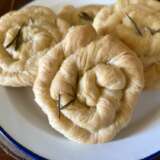
Ricciola brioche from Imola
Equipment
- planetary mixer
Ingredients
- 90 g of puff pastry butter + two tablespoons flour 00, about 50 g
- 25 g of fresh brewer's yeast + 10 g of warm water
- 500 g of 00 flour
- 20 g of lard
- 10 g of salt
- 10 g of olive oil
- 300 g of water at room temperature
Instructions
- Quickly work the cold butter with the flour into a flat, two-cm-high rectangular. This step is essential to prevent the butter from breaking during flaking. Set aside.
- Dissolve yeast in a little warm water and set aside.
- In the bowl of the planetary mixer, combine flour, lard, olive oil, salt, and the yeast dissolved in the water. Mix with the dough hook whisk as you pour in all the water, a little at a time. Knead the dough for about 10 minutes. When the dough is well blended and homogeneous (it looks sticky but handles well when you start working it), turn it onto a lightly floured work surface, dust it with a bit of flour, roll it out with a rolling pin, forming a rectangular, and let it rest for 5 minutes.
- Meanwhile, bring the oven to 30C degrees (86F), placing a saucepan of hot water inside to create moisture. Ideally, you should have two ovens: one as a leavening chamber and the second for baking. In fact, the brioches should immediately enter the already hot oven after resting. If you do not have two ovens, prepare several dishcloths to cover the pan and keep it warm during the rest.
- Arrange the butter in the center of the dough and close the dough over it, forming a package (see photo below).
- With a rolling pin, roll out the dough to a thickness of about 2 cm, forming a rectangle. If you have one, use a heavy rolling pin, such as a marble one. Or impart as much force as you have.
- Fold the dough over itself in a wallet shape, making two folds, one on top of the other, thus forming three layers.
- Roll out the dough again with the rolling pin and repeat the folds twice (three in all, okay?). Each time you make the folds, roll out the dough with the rolling pin to a height of 2 cm.
- Take the dough and cut many strips from the long side of the rolled-out dough with a sharp knife.
- Starting from one side, curl each strip like a snail. Practice, a little at a time, will help you improve the look.
- Arrange the rolled brioches on one or two baking sheets covered with kitchen paper and place them in the oven at 30C (86F) degrees for about 40 minutes without opening the door. Leavening at this stage is very delicate.
- Bring the oven to 200C (392F) degrees. Meanwhile, also prepare chopped rosemary and coarse salt. When the rising time is over, sprinkle the brioches with coarse salt and rosemary.
- Bake in the preheated oven for about 20 minutes or until golden brown.
- Let rest for at least half an hour before tasting.
Tip
- Store out of the refrigerator in a metal box for a few days.