

Pellegrino Artusi, the gastronome who wrote the first collection of Italian recipes on a national scale, dedicates two recipes to Torta Ricciolina or Torta di Tagliatelle (although the more correct term would be Torta di Tagliatelline, since tagliolini are used instead of egg tagliatelle).
There are several variations of this dessert, and more than one city claims the recipe as its own.
Knowing its origins is therefore the only way to clarify and establish who it belongs to.
Origin of tagliatelle cake
First of all, it is a traditional dessert from Emilia, in particular Ferrara, consisting of three layers: a shortcrust pastry base, a filling of almonds and sugar, and a layer of tagliolini.
The first written references to this dessert, although it is considered a dessert, have more the consistency of a dry cake and date back to the Renaissance, placing it within the domains of the Este family.
Legend has it that it was created inspired by the long, blonde hair of Lucrezia Borgia, lady of the city of Ferrara, after her marriage to Alfonso I d’Este, Duke of Ferrara, Mantua, and Reggio Emilia.
The area of origin is Ferrara, but it is more widely known. So the correct answer to the initial question, “Which city does the recipe belong to?”, is all of them.
In fact, it belongs to the culinary tradition of all the cities under the Este dominion (Modena, Reggio Emilia in Emilia-Romagna, Mantua in Lombardy). It arrived in Bologna due to geographical proximity, as borders are places of passage and exchange of people, goods, ideas, and even flavors.
Locally, some variations have emerged. The Mantua version has several layers of tagliolini and no candied fruit; the Modena version calls for cocoa powder and Sassolino liqueur (typical of the city).
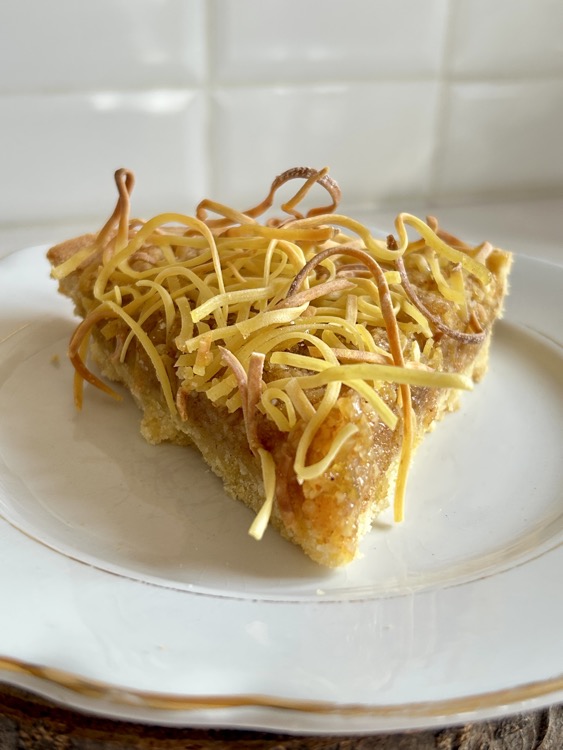
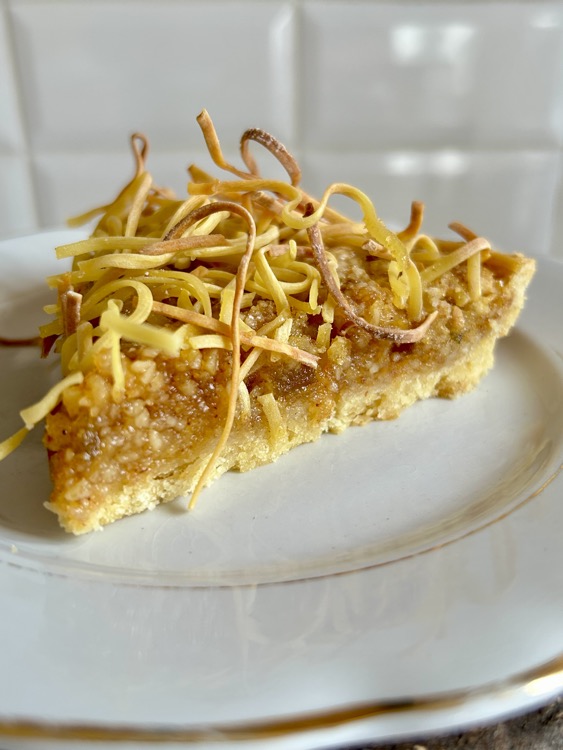
The Bologna version often has no candied fruit, and some people add a few amaretti biscuits to the filling. A recipe summarizing the different versions is filed with the Bologna Chamber of Commerce.
Finally, there is the interesting case of the municipality of Molinella (province of Bologna), which claims local origin for Torta di Tagliatelline and has therefore registered it as a De. Co. product (product with municipal designation of origin). In reality, there are no written sources to prove this, and the municipality of Molinella itself has specified that it is a version from the early 1800s that has been handed down orally.
Throughout Emilia-Romagna, including Romagna, there are different versions of the same recipe. Still, everywhere it is a festive cake, with some people making it for Christmas and others for Easter.
It has a rich flavor and can be cooked in advance, as was once customary, because it tastes better that way.
Artusi’s Ricciolina Cake and my recipe
In The Art of Eating Well, the gastronome reports two distinct versions.
He decided to modify a version he had tried (Recipe No. 578) to make it “more appealing in appearance and more delicate in taste.” This recipe does not include shortcrust pastry, and the dessert resembles the Mantua version, which consists of several layers of tagliolini.
In the second (No. 579), in addition to introducing shortcrust pastry, he chose to use candied orange rather than citron.
- I tried it with and without bitter oranges. I liked it both ways, but I prefer candied citron.
- Grated lemon zest is essential for me.
- Among the many versions I have read (and tried) is one with crumbled amaretti cookies, which works well because it brings out the almonds’ flavor (you can add 30 g of finely chopped amaretti biscuits to the recipe ingredients. They add a more intense nuance of color to the filling).
- Fresh pasta, preferably thin tagliolini, never tagliatelle, which you can buy or make yourself. If you choose to make it yourself, you can find the method on the blog.
- In the Bolognese version, candied fruit is optional.
Other traditional desserts from Bologna
- Torta di Riso of Bologna
- Fior di latte or Portuguese Milk Pudding
- Zuppa Inglese
- Raviole cookies
- Pinza, the ciambella of Bologna
Keep in Touch
- I write a newsletter called Kitchen Notes from Bologna, where you can find stuff about food history, culinary memories, and recipes.
- I’m on Instagram!
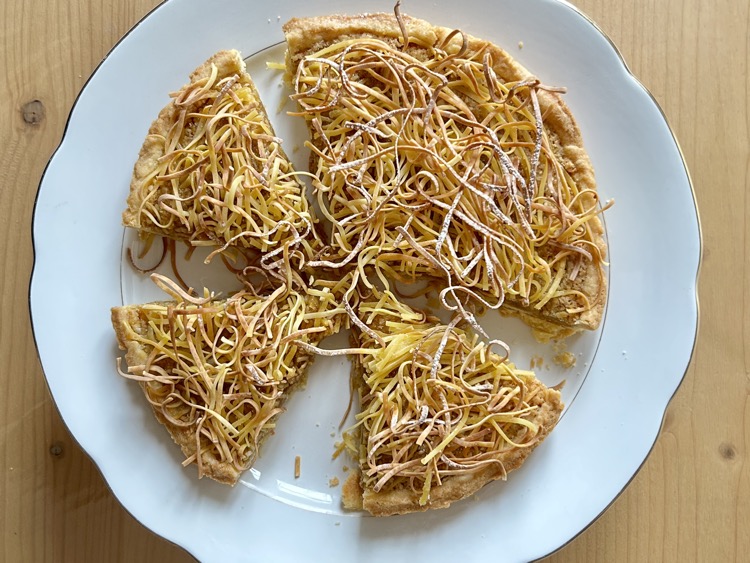
Tagliatelle cake or Ricciolina cake
Equipment
- 1 round cake pan, 21 to 23 cm in diameter. You can use two smaller round pans to make two cakes, or one rectangular pan.
Ingredients
Shortcrust pastry
- 200 g of all-purpose flour
- 50 g of powdered sugar
- 1 pinch of salt
- 100 g of butter, straight from the refrigerator
- 1 egg, 55 to 65 g
- 1/2 teaspoon natural vanilla extract
Filling
- 200 g of blanched almonds
- 100 g of caster or cane sugar
- 1 egg, approx. 60 g
- grated zest of 1/2 organic small lemon
- 60 g of candied citron or candied bitter orange optional
- 100 g of Disaronno almond liqueur or rum
Topping
- 80 g of fresh egg pasta tagliolini
- 60 g of butter
- powdered sugar to taste
Instructions
Shortcrust pastry
- Mix the flour, salt, and sugar in a bowl.
- Add the butter, cut into small pieces, and the whole egg.
- Knead with the fingertips, avoiding overheating the butter, until the dough is smooth and compact.
- Wrap in plastic wrap and refrigerate for at least 1 hour.
Filling
- Meanwhile, preheat the oven to 180 °C (350°F), on the static setting.
- Toast the almonds in a pan for two minutes.
- Chop 1/3 of the almonds with a knife and blend the rest with the sugar in a mixer.
- In a bowl, combine chopped almonds with almond and sugar powder, then mix.
- Add the grated lemon zest, chopped citron, egg, liqueur, and mix.
Assembling cake
- Roll out the shortcrust pastry to a thickness of about 3 mm, line the tart tin, covering the edges, trim and remove any excess pastry from the edges with a knife.
- Pour the filling into the tart. The filling should come just below the edge of the pastry and the mold.
- Spread the fresh, uncooked tagliolini over the cake.
- Distribute butter flakes on the surface and dust with powdered sugar.
- Cover the cake with a sheet of aluminum foil that will be easy to remove during baking.
- Bake in a preheated oven for 15 minutes.
- After this time, remove the cover and continue baking for another 30 minutes or until the tagliolini and the edges of the cake are golden brown.
- If the tagliolini are not brown enough, turn on the grill function during the last few minutes of baking or, if you don't have a grill, extend the baking time by a few minutes
Tips
- This dessert tastes better after a day of resting.
- In any case, allow the dessert to cool completely before serving.
- Store outside the refrigerator for up to a week.


