
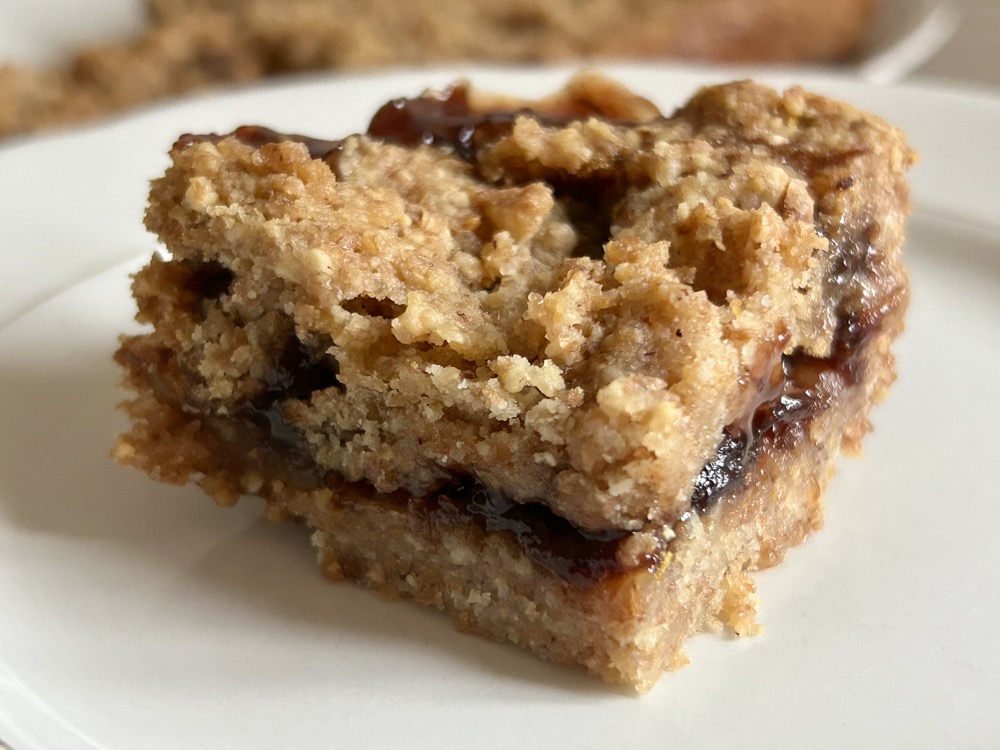
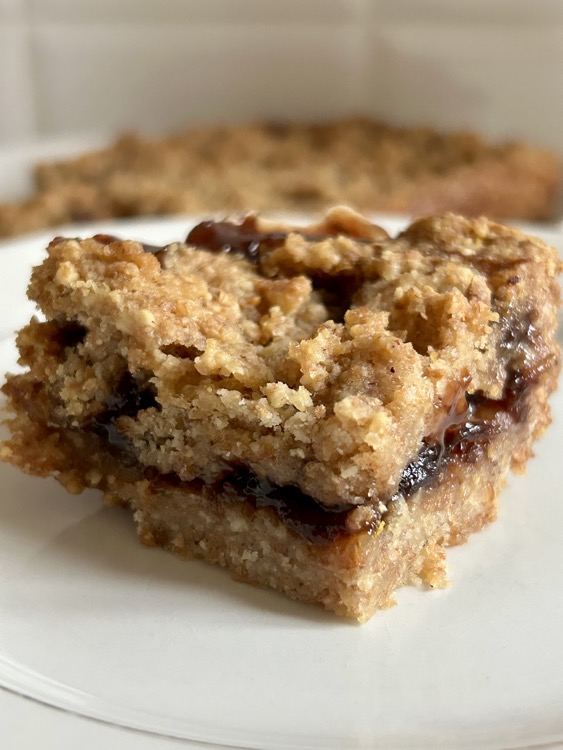
The 125 tart is made with four ingredients in equal amounts, 125 grams each.
Four-quarter cakes are soft, buttery desserts made with four basic ingredients: flour, butter, sugar, and eggs, in equal amounts. Usually, the weight of the eggs determines the quantities of the other ingredients, making it a perfect base for tall, fluffy cakes.
All clear?
Well, forget about four-quarter cakes, because this dessert uses the same amount of each ingredient in the base, but without eggs. And, most importantly, the final result is more like a tart than a cake.
In this recipe, the name comes from the amount of the ingredient weights in grams.
I chose to call it that because it was passed on to me as “125.”
Word of mouth
I accidentally found the Crostata 125 (tart 125) recipe one January morning at the English school I attend. Anyone who knows me is aware of my passion for cooking and my job as a food writer and kitchen instructor, even my teacher, who, for a time, couldn’t wait to share a recipe with me that he had received from a Bolognese cook who had heard it from a friend.
Word of mouth is as rare as a handwritten letter.
Recipes are now on the Web.
That’s why a recipe whispered in my ear is a kind of poetic gift.
It’s a typical Italian home cake, both for its everyday ingredients and its ease of preparation.
And since it’s a gift I’m happy to share, I’m leaving you the recipe.
I’ve done a few test runs and hope to spare you the most common mistake of all: changing a little something here and there, thinking, “What’s the worst that could happen?” Nothing serious, usually.
Except when it tastes not very good or downright bad, and then blaming the recipe when the one that didn’t work is actually yours, the one you altered, not the original.
Tests I’ve make for you
- I made the cake using granulated sugar and brown sugar. In this recipe, I prefer brown sugar, but you can use whatever you have on hand or prefer.
- One time I reduced the amount of sugar and, another time, the amount of butter. If you do this, know that you’ll end up with a cake that bears no resemblance to the original flavor of the tart 125, which, by the way, is absolutely amazing. Stick to the recipe’s listed quantities for each ingredient, or take full responsibility for the results. If you reduce the amount of butter, the cake will be less crumbly and more powdery. It will also be harder to knead. If you cut a part of sugar, the result will be a cake that’s not very crunchy and rather bland.
- I substituted whole wheat flour with buckwheat flour. If you like the taste of buckwheat or want a gluten-free cake, use this flour.
- I paired the buckwheat flour with plum jam and the whole wheat flour with blueberries. You can choose your favorite without fear of making a mistake.
- While kneading, you might be tempted to add some liquid. Resist and keep kneading, it’ll all work out.
I also rely on word of mouth! If you like my work, share it with anyone who loves stories and recipes that taste great. Grazie, x
Keep in Touch
- I write a newsletter called Kitchen Notes from Bologna, where you can find stuff about food history, culinary memories, and recipes.
- I’m on Instagram!
Jam tart 125 (egg-free)
Equipment
- 1 15×21 cm baking pan (or you can use a round baking pan)
Ingredients
- 125 g of finely chopped almonds or hazelnuts
- 125 g of whole wheat flour or buckwheat flour
- 125 g of brown sugar
- 125 g cold butter (straight from the refrigerator)
For the filling
- 200 g of your favorite jam
Instructions
- Preheat the oven to 180 °C (350°F) (conventional setting).
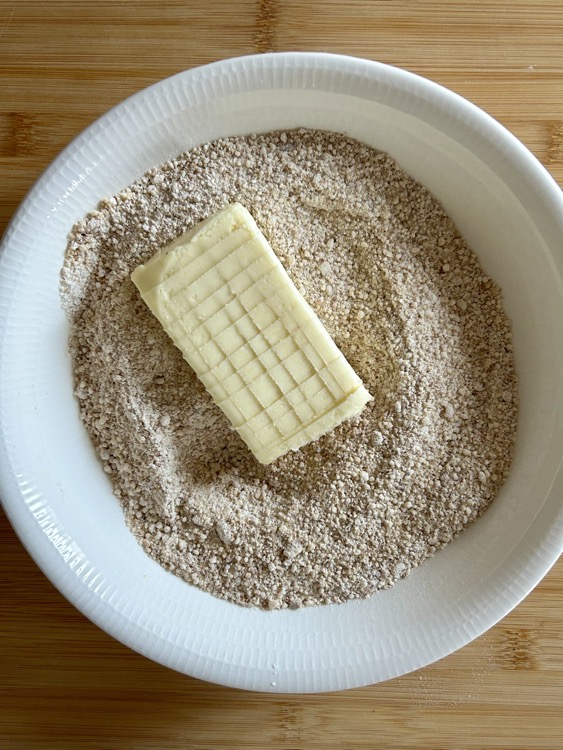
- Weigh the ingredients. In a bowl, combine the dry ingredients and mix. Add the butter in small pieces, then rub it in with your fingertips to avoid overheating it. At first, the dough will seem crumbly, as if it needs an egg yolk or milk. Give the butter time to bind everything together; trust the recipe.
- Let the dough rest for a few minutes at room temperature (read the tips first).
- Line a baking pan with wet, wrung-out parchment paper; use your fingers to spread ¾ of the dough over the bottom, taking care to form the edges.
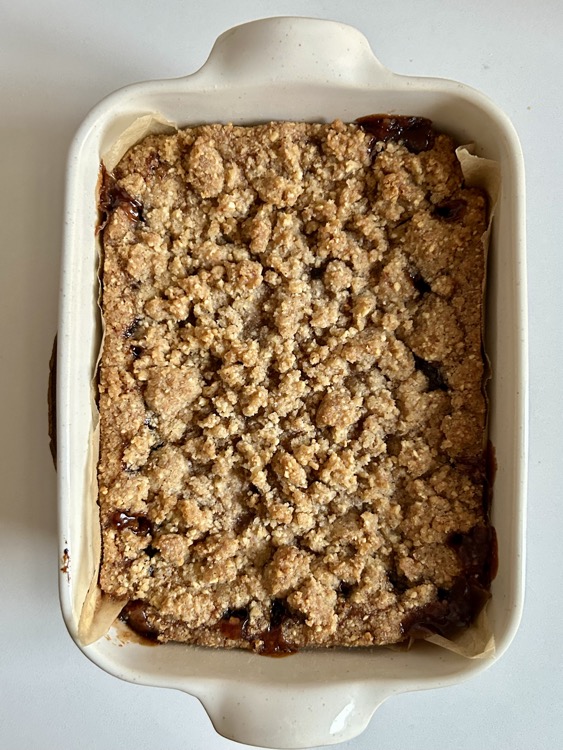
- Spread the jam over the bottom of the cake.
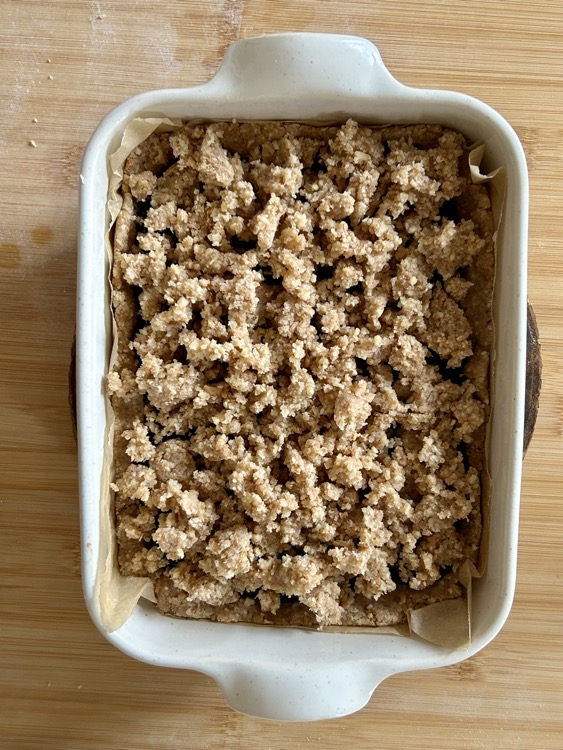
- Crumble the remaining dough evenly over the cake surface, as if making a crumble.
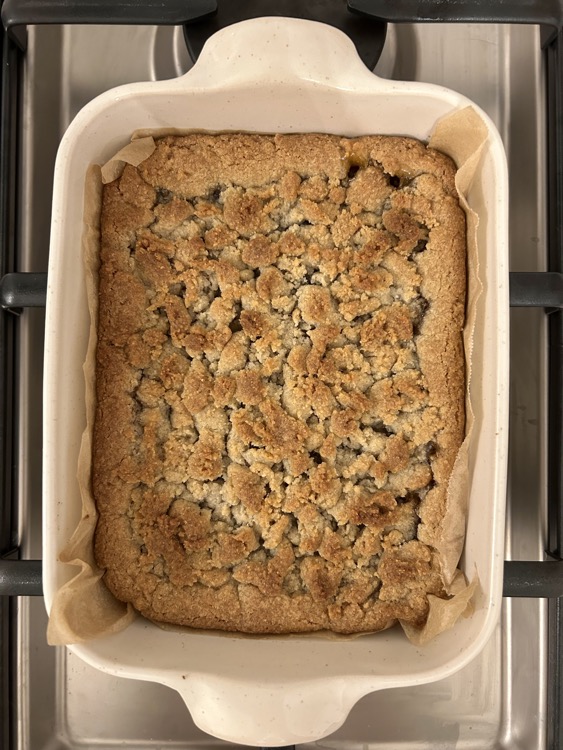
- Bake for 35 minutes in a preheated oven.
- Let cool before serving.
Tips
- Usually, shortcrust pastry dough needs to rest in the refrigerator before being rolled out. In this case, that's not necessary; you can use the dough right away as long as 1) the butter hasn't been worked for too long and doesn't need to be chilled, or 2) it isn't very hot (in your kitchen or outside the kitchen). In these cases, if the dough needs to rest, preheat the oven before you roll out the crust.
- Store outside the refrigerator for a few days.
Women’s networks before the Internet
I got this recipe through word of mouth. And it’s not as trivial as it seems.
Before the Internet became the main source for finding recipes, there was word of mouth.
It was an invisible network that connected women of the past. Just as the Internet is wireless, the exchange took place orally or via letter.
Illiteracy, which persisted for many women until the mid-20th century, also favored this predominantly oral transmission.
And while writing down a recipe on a piece of paper is a old practice, for women, it was a milestone linked to the recognition of the right to education or to the individual’s willpower to better themselves through self-study. The first home-cooked notes, diligently written in a notebook, represent the ancestors of cookbooks and, of course, of every food blog.
Throughout the 20th century, letter-writing grew in importance and complemented oral communication. Within a decade after the end of World War II, the telephone became a new tool supporting women’s networks. That wire connected to the wall carried the sound of distant voices, speeding up communication.
I still remember my grandmother, sitting by the phone while jotting down notes on whatever she had at hand, even the envelopes from the last letter she received. And a precious trace of that exchange remains in her notebooks, with their beautiful handwriting and slightly uncertain grammar.
While we access the internet by opening our phones or computers, those women built their own network. And I find comfort in the thought that a part of those early pioneers lives on in each of us every time we share a traditional recipe.


