Nocino is an ancient liqueur traditionally prepared in June to mark the summer solstice.
The beginning of summer is celebrated on June 21, the longest day of the year, but the rituals associated with this event have always placed great importance on June 24 as well, St. John’s day, as the night between the 23rd and the 24th is considered magical.
St. John the Baptist, not to be confused with St. John the Evangelist, was born, as it happens, right in the middle of the calendar at the crossroads of the seasons, and is celebrated with rituals in which fire, water, and food take center stage, recalling the rustic nature of the pagan rituals upon which Christian ones were grafted.
Among the rituals associated with fire and water, the most widespread are nighttime bonfires, to ward off demons, and the tradition of herbs and the so-called guazza (dew) of St. John. According to this ritual, on the evening of June 23, one must place a small bouquet of herbs and flowers in a basin of water set outdoors to collect the night’s dew, which is said to have health benefits.
The same dew also moistened the husks of still-unripe walnuts, making them perfect for making Nocino.
Along the Via Emilia, tortelli di erbetta and Nocino are two culinary traditions linked to the saint’s celebrations and the start of the new season.

Nocino, the spirit of San Giovanni
According to old legends, witches used to gather around the walnut tree, which was considered magical. But harvesting the walnuts on the day of the solstice has mainly to do with the ripening of the fruits.
The ones used to make Nocino must be unripe yet fully formed, with a tender, fragrant green husk. This is the perfect time to harvest them, as Artusi also notes in his brief introduction to recipe no. 750—Nocino.
Climate change affects the growth and ripening processes of traditional fruit trees. Today, the harvest depends on the weather; this means it may take place earlier or later than this date.
In any case, there’s a way to tell if the walnuts are ready. You should be able to insert a needle or a pin into the green shell. If it goes through, the walnuts are ready, and you won’t run the risk of ending up with a green, bitter-tasting liqueur.
The origins of the recipe are ancient and somewhat uncertain.
Possibly of French origin, it might even date back to the Britons. In Italy, the recipe has been known in the Modena area since the 16th century.
The earliest written version refers to a walnut ratafia that appeared in 1766 in the book Il cuoco piemontese perfezionato a Parigi, by an anonymous author.
The production of a liqueur bearing its current name, Nocino, dates back to the period between 1860 and 1867, when Ferdinando Cavazzoni, head steward of the Molza household, included in his cookbook dedicated to specialties “in the Modena style,” the recipe for the liqueur known as Nocino.
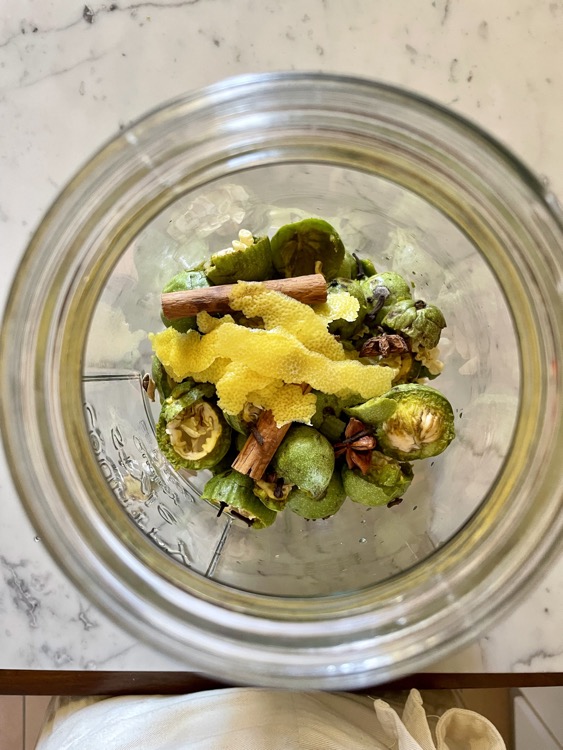
My first time making Nocino
A year ago, for the first time, my husband and I prepared walnut liqueur following one of my home recipes.
In Emilia-Romagna, the preparation of this liquor is widespread, and I grew up watching and helping in preparing liquors, juices, and syrups of all kinds.
I didn’t remember how dangerous green walnut hulls can be for your hands. Remember the latex gloves: the unripe green walnut dye. In comparison, artichokes are a joke. My husband’s hands were stained for a whole week!
Getting back to the recipe, every family has its own.
Some add spices, and others add more or less sugar; some people move or even stir the contents of the jar during steeping, while others won’t touch it.
Here, I share with you the home recipe I tried, which has become the one I use.
The quantity is enough to make a few bottles. They will be ready around Christmas time. In fact, once bottled, Nocino needs a few months to a year to give its best.
Its dark color reminds me of dark chocolate or molasses. It has a balsamic and nuanced flavor.
Serve it after dinner as a digestive or on cold winter evenings as an invigorating drink.
In summer, add a lemon peel and an ice cube.
Buona cucina, Monica
Cook with me
My family traditionally buys a certain amount of walnuts that must be enough for one year. Grandma used to make delicious walnut cookies. In the dough, she would add a little nocino. You can find the recipe here.
How to make San Giovanni’s bunch
The blooms change depending on where you live; therefore, the bouquet’s composition may change. Of course, you can also personalize it by choosing herbs and flowers based on their meanings or properties.
Let’s say hypericum, also known as St. John’s wort, is a must.
Compose with lavender, mugwort, rosemary, mallow, yarrow, garlic, rue, fern, or mint. The bunch should consist of 6 to 9 herbs.
On the evening of the 23rd, immerse the bunch in a water bowl and leave it outside to catch the night’s dew. The following morning, rinse your face with that water: it protects against diseases and makes the skin bright and fresh.
Keep in Touch
- I write a newsletter called Kitchen Notes from Bologna, where you can find stuff about food history, culinary memories, and recipes.
- I’m on Instagram!


Nocino liquor: a recipe from Emilia-Romanga
Equipment
- Latex gloves; a 2-liter capacity jar with cap
Ingredients
- 700 ml of water
- 700 g of caster sugar
- 30 green walnut hulls I recommend you buy a few extra in case some of them are spoiled (which you won't know until you open them)
- 1 liter pure grain alcohol (95% alcohol)
- 1/2 organic lemon, zest fillets
- 2 cinnamon sticks
- 10 cloves
Instructions
- Put the water in a saucepan and bring to a boil. Turn it off, pour the sugar, and dissolve it while stirring.
- Let the syrup cool.
- In the meantime, rinse the green walnuts under running water and dry them one by one to prevent the liquid from molding or becoming too diluted (at the end of the resting period, I taste it and, if necessary, adjust it by adding water).
- Meanwhile, put on rubber gloves and cut the walnuts into 2 or 4 parts. You can use a cleaver-type knife or, more conveniently, a nutcracker. If, when you crack open the green walnuts, you see black spots inside, throw them away.
- Put the walnuts in the jar, and add the alcohol, sugar-water syrup, and flavorings.
- Seal the jar tightly and place it in a dark spot in your pantry or closet. Let the Nocino age for a tantalizing 40 days, allowing the flavors to meld and deepen.
- Sugar tends to crystallize and, therefore, end up at the bottom. Once a week, move the jar vigorously or stir the liquid with a spoon.
- After this time, strain and taste. If you find too strong, add 100 ml of water once or twice (to your taste). Stir and bottle.
- Consume after a few months.