The recipe for anolini belongs, albeit with differences in shape and filling, to the territories of Parma and Piacenza. This recipe for cheese anolini from Val d’Arda is a variation of the classic anolini recipe from Piacenza and Parma.
The Val d’Arda is a picturesque valley in the Piacenza Apennines, crossed by the Arda stream, famous for its medieval villages, geological formations called calanchi, hilly landscapes rich in vineyards, and hiking trails. In addition to a wide and interesting range of food and wine.
Carmen Artocchini, one of the most authoritative sources on Piacenza cuisine, mentions cheese anolini in her book 400 ricette della cucina piacentina, describing them as a gastronomic excellence of the province.
Cheese Anolini
They are also called anolini di magro (lent anolini) or anolini vergini (virgin anolini) because the filling is without meat. Although it is not really true, since the breadcrumbs in the filling are moistened with meat broth.
Indeed, unlike the classic anolini from Piacenza, which are made with shreds of braised beef or its sauce, those from Val d’Arda are linked to the history and culture of a region where meat was historically used less frequently than cheese.
I like to taste the flavors of the recipes of the Via Emilia that I did not grow up with and that I have discovered through the journey I have undertaken with this blog.
However, when making these anolini, after consulting with my source, a true Piacenza native from Val d’Arda, I made a mistake that she rightly pointed out to me. To make the anolini, I used a smooth mold instead of a serrated one. Otherwise, the recipe for the filling and the amount used to stuff the pasta were approved.
History of classic anolini from Piacenza and Parma
The term anolino derives from its shape and the Latin word anulus, which means ring.
It is a type of stuffed egg pasta typical of the areas of Piacenza (in dialect anvèin) and Parma (in dialect anolèn).
In the province of Cremona, there is a variant known as marubini (in dialect, marubèn, a name also heard in old families in the north-eastern plains of Piacenza).
Salimbene de Adam, an Italian historian and religious from Parma, wrote about anolini in his Cronica as early as 1284. This book is a fundamental text for discovering the history, customs, and traditions, including gastronomic ones, of northern Italy in the Middle Ages. Thanks to him, we know that anolini stuffed with meat were a dish for wealthy families. But, it was the Renaissance chef Bartolomeo Scappi who revived the recipe and he left us the first written recipe for anolini.
Anolini from Val d’Arda, like cheese cappelletti from Romagna, were more affordable dishes than the sumptuous meat anolini, cappelletti from Reggio Emilia and Ferrara, and tortellini from Bologna and Modena.
You can cook them in a broth:
You will find the procedure for making egg pasta dough: HERE
Keep in Touch
- To receive unpublished recipes, tips, and food stories, sign up for the Tortellini&CO newsletter.
- Follow me on Instagram.

Cheese anolini from the picturesque Val d'Arda (Piacenza)
Ingredients
Stuffing
- 100 g of breadcrumbs without flavorings
- 100 ml of broth, I use a meat broth
- 160 g of grated 36-month aged Parmigiano Reggiano
- 100 g of Parmigiano Reggiano cheese aged 24 or 30 months, or Grana Padano cheese
- 1 egg, approx. 65 g if your egg weighs less, use two small or add a little of broth
- salt and nutmeg to taste
Sfoglia (Pasta dough)
- 400 g of 00 flour
- 4 eggs, about 200 g
Instructions
Stuffing
- Place the breadcrumbs in a bowl and pour in the broth. Mix first with a spoon, then with your fingers.
- Add the remaining ingredients and knead first in the bowl, then on a clean surface.
- Form a ball, wrap in plastic wrap, and let rest. If you prepare the filling in advance, store it in the refrigerator, but bring it back to room temperature at least 30 minutes before using.
Sfoglia (pasta dough)
- Place the flour in a mound, crack the eggs into the center, break them with a fork, and begin incorporating the flour. Set aside the fork and use a spatula to finish mixing the eggs and flour, making the mixture lighter.
- After a few minutes, knead with your hands until large crumbs form. Continue kneading until the mixture is soft but not sticky. For instructions on rolling out the dough, see the blog's basic dough recipe. If you don't have much experience, I recommend reading the instructions. You will find a direct link above the anolini recipe.
- Form a ball, cover with a bowl, and let rest at room temperature for 30 minutes.
Assembling cheese anolini
- Roll out a thin sheet of dough, then use a pasta cutter to cut strips as long as you like and 6-7 cm wide.
- Arrange about 2 g of filling in a row, spacing them 1-1.5 cm apart. Place the balls of filling at the bottom of the rectangle of pasta, leaving space between the filling and the edge so that you can form the anolini.
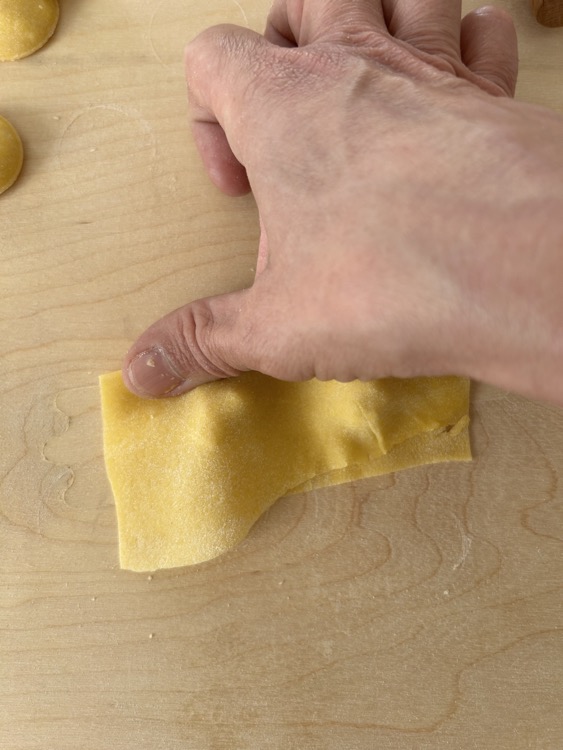
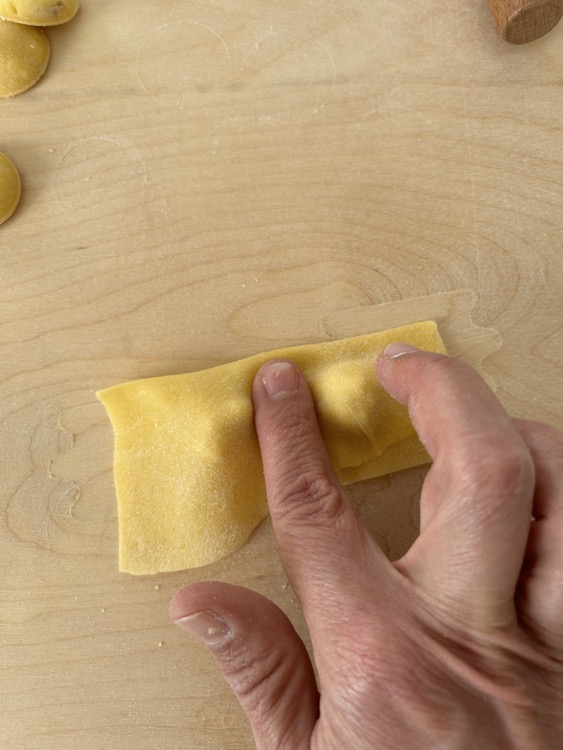
- Cover the filling with the pasta and use your fingers to press down the space between the balls of filling and the edges of the pasta. Use the mold to cut out the anolini and place them on a drying rack to dry for 30 mins.
Tips
- If the dough starts to dry out while you are working, sprinkle it with a little water. This will ensure that the filling remains well sealed between the two layers of dough, which will stick together without any problems.
- If any of the anolini open up, pinch them closed with your fingertips.
- If you think there is air inside the anolini, pierce the dough of each anolino with the tip of a clean needle. This will prevent them from opening during cooking.
- You can prepare the filling the day before and store it in the refrigerator wrapped in plastic wrap.
- Store the anolini in the refrigerator for 1 day or, once they have dried, in the freezer for up to a month.