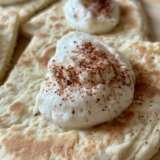
Sweet piadina of Romagna
The sweet piadina romagnola is a specialty of Emilia-Romagna. Turn it into a cucina povera dessert with a ricotta cream quenelle.
Servings 6 serves
Ingredients
- 200 ml of milk
- 500 g of flour, for me half 00 and half spelt
- 175 g of cane or granulated sugar
- 3 g of baking soda or 2 g baking powder for cakes
- 1 egg, about 60-70 g
- 40 g of lard or 20 g olive oil
- grated lemon zest for flavor, just a little
Instructions
- Warm the milk on the stove and set it aside.
- You can knead by hand or in a stand mixer. I'll leave you with the first method; if you use a stand mixer, follow the instructions for adding the ingredients.
- In a large bowl, mix the flour, sugar, baking soda, or baking powder.
- Make a well in the center and pour in the egg, lard, or olive oil. Pour in half the milk and mix with a fork until large crumbs form. If using a stand mixer, turn it on to speed 1 (dough hook) while pouring in the remaining milk a little at a time.
- Add the salt, distributing it over the dough in the bowl, and the lemon zest.
- Now add the rest of the milk a little at a time, if needed. If the dough seems too sticky, stop; you will have to correct it by adding more flour (if, on the other hand, it seems too hard, add a tablespoon of milk or water at a time until it becomes soft).
- Transfer the dough to a clean surface and finish kneading with your hands as if it were dough for fresh pasta. Form a soft, but not sticky, ball, then divide it into 4 pieces for 4 large piadinas or 6 for smaller piadinas. Cover with a cloth and leave to rest at room temperature for 30 minutes. Piadina does not rise; it rests.
- Dust the pastry board with flour and roll out each ball of dough with a rolling pin into a thin circle, a few millimeters thick.
- Prick the surface with the prongs of a fork and cook each piadina on a hot griddle for a few minutes on each side. When colored spots form on the surface, turn the piadina over and cook for a few minutes or until a speckled effect forms.
- Cut the piadinas into wedges and spread the ricotta cream on each piece.
Tip
- You can cook the piadine and, once cooled, store them in the freezer for up to a month.